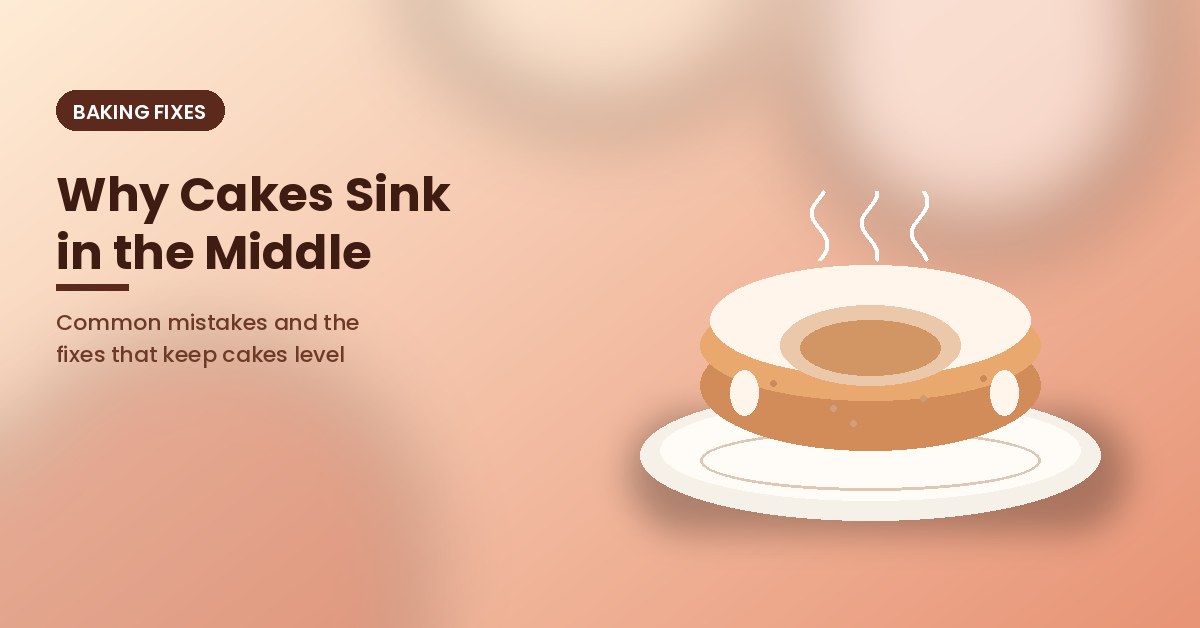
You pull the cake from the oven looking proud of yourself. Ten minutes later the center has dropped into a sad little crater, and the edges are still standing like a rim. That moment is how most bakers learn the hard way why cakes sink in the middle.
The good news is that a sunken cake is almost never a mystery. Something about the batter rose too fast, set too late, or never had enough structure to hold the rise. Once you know which of those happened, the fix is usually small and very doable.
This guide walks through the most common baking mistakes behind a collapsed center, how to check for them, and what to change next time so the cake comes out level.
What actually keeps a cake from collapsing
A cake rises because air and gas expand in the heat of the oven. Those bubbles come from creaming butter and sugar, from whipped eggs, and from baking powder or baking soda reacting with liquid and heat. While the bubbles grow, the proteins in eggs and the starches in flour gradually set into a soft network that can hold the shape.
If the bubbles get huge before that network is ready, the middle caves in as the cake cools. If the structure never develops enough strength in the first place, the same thing happens. Every mistake below is a version of one of those two problems.
Underbaking: the most common reason cakes sink in the middle
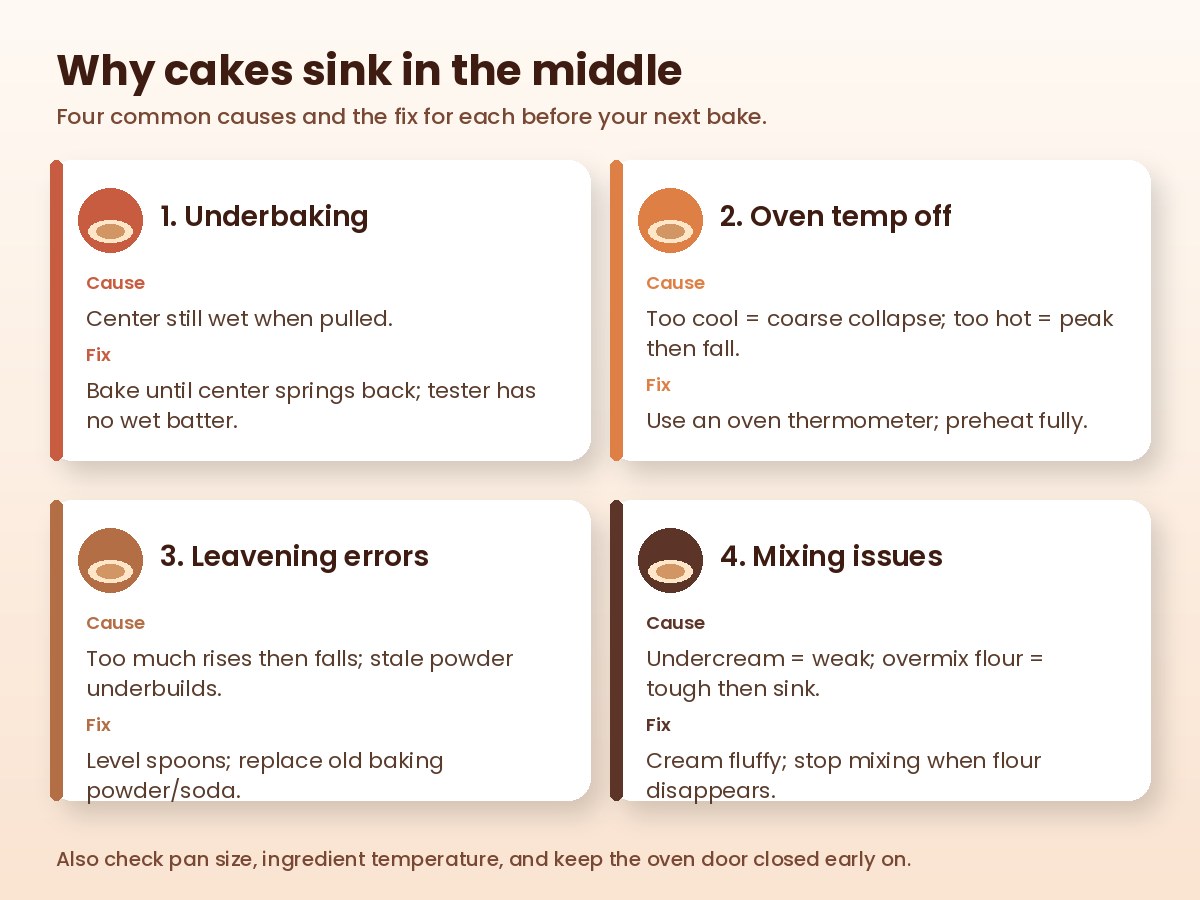
Underbaking is the culprit more often than bakers want to admit. The outer ring of the cake sets first because it is closer to the hot pan. The center stays wet longer. If you pull the pan while that middle is still soft batter rather than set crumb, it looks fine for a minute and then sinks as it cools.
A toothpick test helps, but it is not the whole story. Push a skewer or thin knife all the way into the center, not just an inch down. Wet batter on the tip means more time. A few moist crumbs are usually fine for a butter cake; a shiny smear of batter is not.
Better still, look at the whole cake. The top should look set, not glossy. The edges should be pulling slightly away from the pan. Press the center gently with a fingertip: it should spring back, not leave a dent. Baking times on recipes are a guide, not a promise. Oven quirks, pan material and batter temperature all shift the clock.
For a deeper look at doneness cues that go beyond the toothpick, the King Arthur Baking guide to telling when a cake is done is worth bookmarking.
Oven temperature that runs hot or cold
An oven that is cooler than the dial claims lets air cells grow slowly and get oversized before the structure sets. The crumb ends up coarse, and the middle often collapses under its own weight. An oven that runs hot can set the outside early while the center is still wet, so the cake peaks and then falls once the soft middle tries to catch up.
The fix is an inexpensive oven thermometer. Place it in the center of the middle rack, heat the oven to 175°C (350°F), and check the reading after twenty minutes. Take a few readings over the next half hour. If the average is off by more than about 10°C (roughly 20°F), adjust the dial or have the oven calibrated.
Also give the oven a real preheat. Putting a pan into a half-warmed oven is a quiet way to underbake the center even when the timer looks right.
Too much or too little leavening
Baking powder and baking soda are powerful in tiny amounts. Too much and the cake rockets up, then the fragile foam collapses before the crumb can lock in place. Too little, or stale leavener that has lost its punch, and the cake never builds enough lift or structure, so dense spots and a soft middle show up instead.
Measure carefully. Level the spoon; do not heap it. If your baking powder is older than about six months, or your baking soda has been open a long time, test it. Stir half a teaspoon of baking powder into a little hot water: it should fizz strongly. For baking soda, a drop of vinegar should make it bubble hard. Weak fizz means replace the tin.
King Arthur’s bakers often see over-generous scoops of baking powder as a reason cakes rise beautifully and then fall, which matches what home bakers describe when they ask why a cake fell flat.
Mixing mistakes: undercreaming, overcreaming and overmixing
Creaming butter and sugar is not just about blending. Beating soft butter with sugar cuts tiny air pockets into the fat. Those pockets expand in the oven and help the cake rise. If the butter is too cold, or you stop as soon as the mixture looks vaguely combined, you get fewer air cells and a weaker batter. The cake can look dense and still sink where the structure is thinnest.
Overcreaming goes the other way. Too much air makes a batter that balloons in the oven and then collapses. Aim for light and fluffy, usually three to five minutes on medium with room-temperature butter, not a long high-speed whip.
Once the flour goes in, switch to a lighter touch. Overmixing develops gluten. Some gluten is useful for holding the rise; too much makes the cake tough and can also encourage a big rise followed by a fall. Mix only until the dry streaks disappear. A few tiny flour flecks are safer than a long, vigorous beat.
Opening the oven door too early
Curiosity is expensive in cake baking. Opening the door in the first two-thirds of the bake dumps heat and can make a rising cake stutter. The center is the last part to firm up, so a sudden cool draft hits it hardest. Wait until the cake is close to the earliest time on the recipe before you peek, and open the door briefly.
If you need to rotate the pan for even browning, do it in the last third of the bake, when the structure is mostly set.
Wrong pan size, dark pans and overfilled tins
Batter depth matters. A recipe written for two 20 cm (8-inch) pans will behave differently in a single deep 23 cm (9-inch) pan. Extra-deep batter takes longer to set in the middle, which raises the chance of a wet center and a sink. Fill cake pans about halfway to two-thirds full unless the recipe says otherwise.
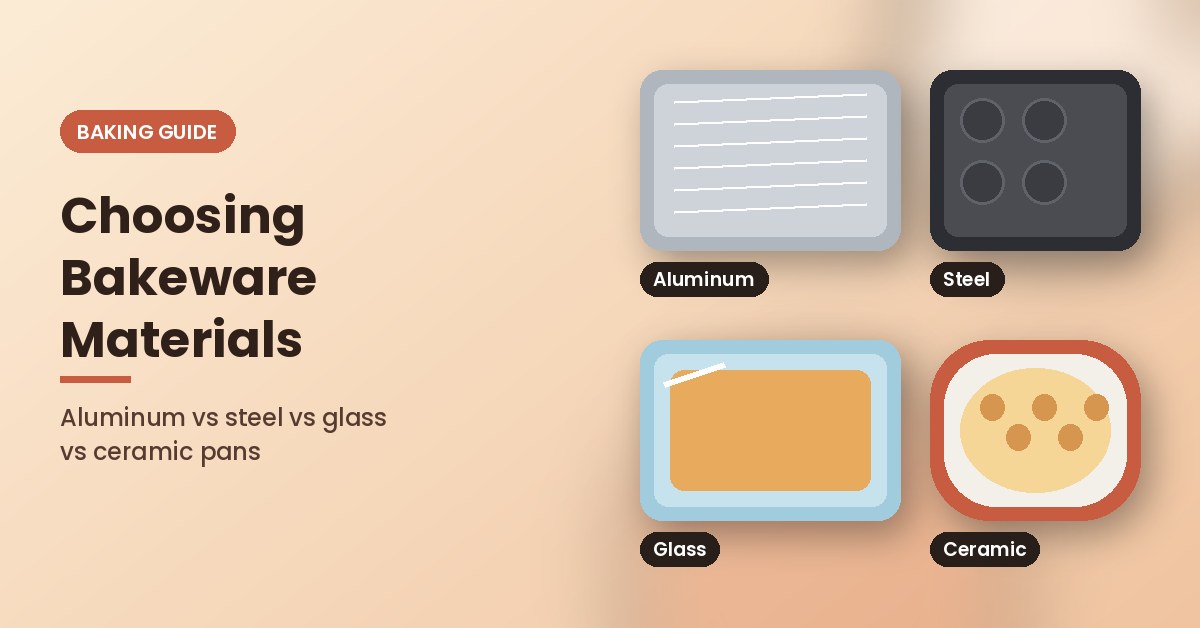
Pan material changes heat transfer too. Dark metal pans absorb more heat and can brown and set the edges faster than a light aluminum pan. Glass and ceramic heat more slowly and hold heat longer, so the same recipe may need a lower temperature or a longer bake. If you are choosing pans for more even cakes, our guide to choosing bakeware materials explains how aluminum, steel, glass and ceramic each affect browning and bake time.
For skillet cakes and cornbread, a well-seasoned cast iron pan can give a beautiful crust, but it also runs hot at the edges. That is useful when you want a browned rim, and it is another reason to watch the center carefully. Everyday care for that pan is covered in our guide on how to season and care for a cast iron skillet.
Ingredient temperature and measuring problems
Cold eggs or cold milk added to creamed butter can seize the fat into little lumps. The batter looks curdled, air distribution suffers, and the crumb bakes unevenly. Bring eggs, dairy and butter to cool room temperature before you start. Butter should yield slightly when pressed, not melt into oil.
Measuring flour by scooping the cup straight from the bag packs in extra flour. Extra flour makes a stiffer batter that can still sink if the center underbakes, or bake up dry and peaked. Spoon flour into the cup and level it, or better, weigh it. Most classic butter cakes land near 120 to 125 grams per cup of all-purpose flour, depending on the recipe’s convention.
Moving and cooling a fragile cake
Even a fully baked cake can dent if you slam the pan on the counter or tip it out while the crumb is still steaming soft. Let layers cool in the pan on a rack for 10 to 15 minutes, then turn them out. Sudden temperature shocks are less of a problem for most butter cakes than underbaking, but rough handling of a just-baked center can leave a permanent dip.
If a cake still sinks a little after you have fixed the bake, you can level the top with a serrated knife and use the cake for layers or a trifle. The flavor is usually fine; the problem was structure, not taste.
A quick checklist before your next bake
Run through this list once before the mixer comes out. It catches most of the reasons why cakes sink in the middle without turning baking into a science project.
- Preheat fully and confirm the oven with a thermometer if cakes often misbehave.
- Use room-temperature butter, eggs and dairy for even creaming.
- Measure leavening carefully and replace stale baking powder or soda.
- Cream until fluffy, then mix in flour only until combined.
- Use the pan size the recipe calls for and avoid overfilling.
- Bake until the center springs back, the edges pull away, and a tester comes out without wet batter.
- Keep the door closed until the cake is nearly done.
When a sunken cake is still salvageable
Do not throw a collapsed cake away on looks alone. If it is cooked through, slice off the dome or fill the crater with frosting, whipped cream, fruit or a ganache puddle. Cupcakes made from leftover batter, cake pops and layered trifles all forgive an imperfect rise. Save the drama for the next bake, when the checklist above usually prevents a repeat.
A flat middle feels personal. It rarely is. Fix the structure timing, keep the oven honest, and treat leavening and mixing with a light, accurate hand. That is most of the craft of a cake that stays tall after it cools.